|
|
|
Rascal Flats Labs Chesters' Parents
Roxy's Parents
Abby's Parents
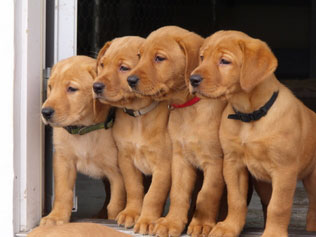
Color Facts In a litter of fox reds you will always get a variation of shade from medium to dark., even on breeding fox red to fox red, much the same as the variation of color on yellows or chocolates. On all fox red puppies, as they get older, the color will darken, usually up to the age of about 2-3 years. When you look at a new puppy ,you are looking at the undercoat, not the guard hairs, it is the guard hairs that determine the variation of the body coat, medium to dark. This undercoat will appear to be the color of a brown paper bag. The head and ears should appear to be red, medium to dark, also the pigment should be a peach color, not a bright pink like the yellow. As soon as they are born, they appear fairly dark, within a couple of weeks they lighten up as their undercoat develops. The red will appear as the guards hairs start to grow. All fox red's are registered as yellow.
Interest in the darker shades of gold and fox red were re-established by English breeders in the 1980s, and two dogs were instrumental in this change: Balrion King Frost who consistently sired "very dark yellow" offspring and is credited as having "the biggest influence in the re-development of the fox red shade", and his great-grandson, the famous Wynfaul Tabasco , described as "the father of the modern fox red Labrador",other dogs, such as Red Alert and Scrimshaw Placido Flamingo, are also credited with greatly passing on the genes into more than one renowned bloodline. TemperamentLabradors are a well-balanced, friendly and versatile breed, adaptable to a wide range of functions as well as making very good pets. Labradors have a reputation as a very mellow breed and an excellent family dog including a good reputation with children of all ages and other animals. Females may be slightly more independent than males. Labradors mature at around three years of age; before this time they can have a a lot of puppyish energy, leash-training early on is suggested to prevent pulling when full-grown. Labs often enjoy retrieving a ball endlessly and other forms of activities. Almost every Lab loves playing in water or swimming.They instinctively enjoy holding objects and even hands or arms in their mouths, which they can do with great gentleness a Labrador can carry an egg in its mouth without breaking it. They are also known to have a very soft feel to the mouth, as a result of being bred to retrieve game such as waterfowl. They are prone to chewing objects ,though they can be trained out of this behaviour. Although they will sometimes bark at noise, when there is noise from unseen sources, Labs are not on the whole noisy or territorial, and are often very easygoing and trusting with strangers, and therefore are not usually suitable as guard dogs Labradors have a well-known reputation for appetite, eating digestible and non-food objects alike. They are persuasive and persistent in requesting food. For this reason, you must carefully control their food intake to avoid obesity and its associated health problems The steady temperament of Labs and their ability to learn make them an ideal breed for search and rescue, detection, and therapy work. Their primary working role in the field continues to be that of a hunting retriever.
|